


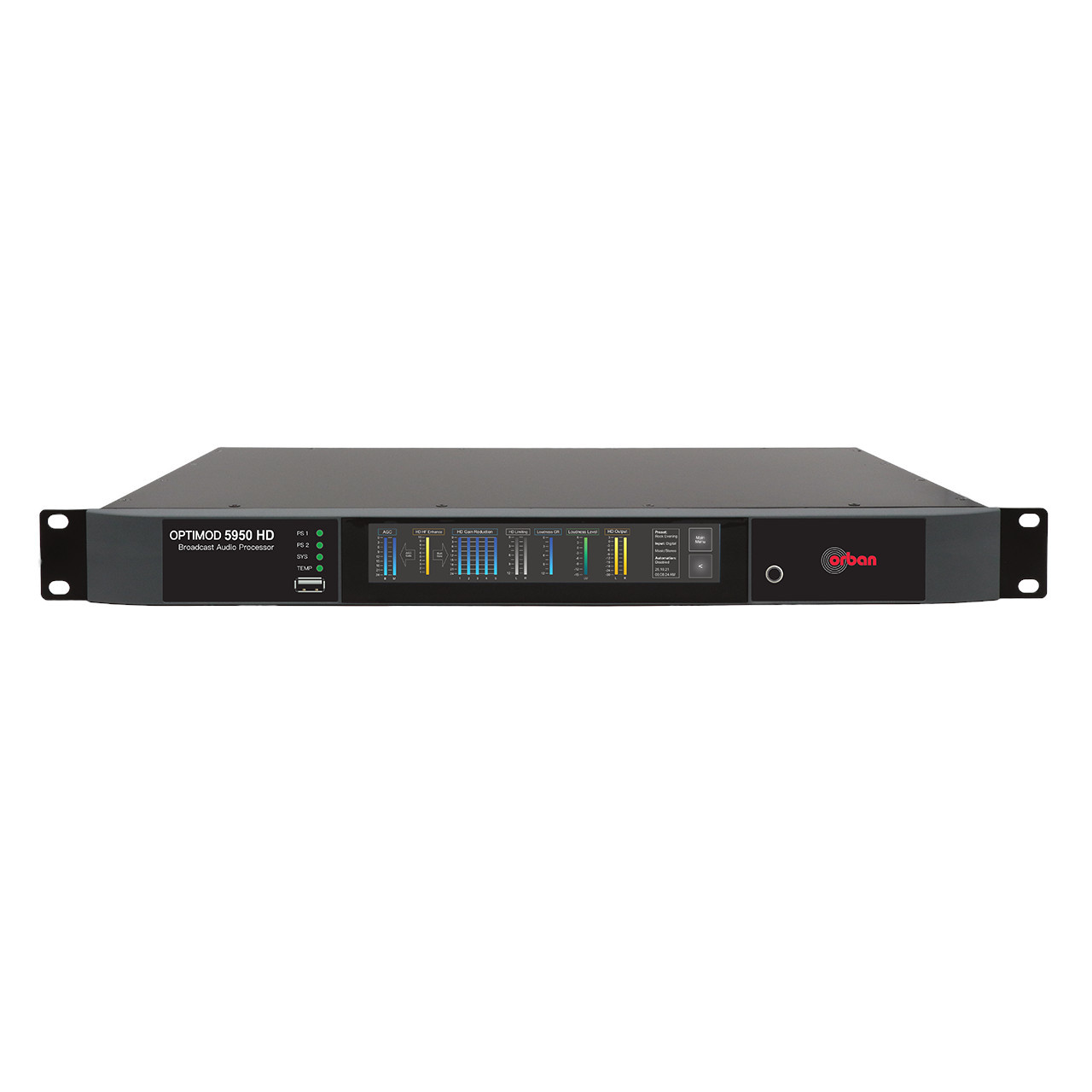


- Main Features:
- Six Processing Structures: Five-Band, Low-Latency Five-Band, Ultra-Low Latency Five-Band, Two-Band, Five-Band MX and Two- Band MX.
- Window-Gated AGC: Intelligent two-band window-gated AGC controls levels subtly and unobtrusively.
- RDS/RBDS: Onboard generator supports dynamic PS scrolling and IP access.
- Factory Presets: Like all OPTIMODs, the 5950 also comes with a variety of factory presets; Orban’s exclusive “Less-More” control simplifies creating your own signature sound.
- AES67/SMPTE ST-2110: Two redundant network interfaces are available for Audio-over-IP connections supporting AES67, RAVENNATM and SMPTE ST-2110. AES67 provides Dante and Livewire+TM compatibility.
- Remote Control/Monitoring: OPTIMOD 5950 can be configured and controlled via any HTML5 web browser. It also supports the SNMP v2 and the Ember+ protocols.
- Measurement Tools: The HTML5 web browser control user interface offers a complete tool set to measure and monitor your audio signals including oscilloscope and FFT displays.
- Audience Measurement: Two internal Nielsen or Kantar Encoders are optionally available, allowing the FM and the DAB+/HD Radio signals to be watermarked independently.
- Streaming Monitor Output: The processed FM or DAB+/HD Radio signals can be monitored remotely via IP, allowing processor adjustment in locations where a clean off-air signal is unavailable.
- μMPX interface: The optional μMPX Interface allows you to transmit DMPX over IP.
FREE SHIPPING ON ORDERS $100 OR MORE *
* Restrictions apply, click here to view our shipping policy